Physics based listening room design
Using state of the art computational techniques, design your room with the acoustics in mind.
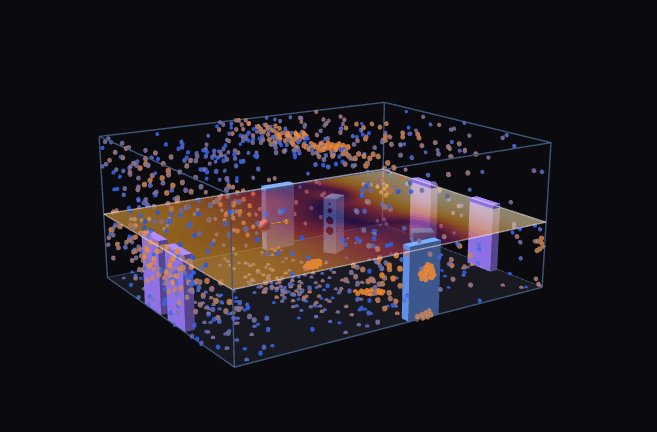
You may have noticed:
frequency response · 20–200 Hz, listening seat
Uneven, booming bass
Some notes hit twice as hard as the rest while others go missing entirely. The same bassline booms at one seat and sounds thin at the next.
stereo width · reflection time, listening seat
Collapsed soundstage
Instead of a wide image spread across the front wall, everything bunches toward the centre. Late reflections smear the cues your ears use to place each instrument.
stereo focal point · left-right symmetry
Off-centre stereo image
The image pulls to one side. A vocal that should sit dead centre drifts left or right, and the two halves of the mix stop carrying equal weight.
Main features
01 · Audio preview
Hear the difference.
Samples played through a synthesis of the room’s acoustics, before and after treatment.
Pick a sound, then press play. Toggle Before / After while it plays.
02 · Placement
100,000+layouts searched
We search for the flattest response and the tightest stereo image.
03 · Panel placement
1,000,000+positions scored
We iteratively find the highest leverage panel placements.
RT60 decay time
reverberation · 20–200 Hz
decay 0.7 s → 0.3 s
Frequently Asked Questions
No — you can draw a room and run the full analysis as a guest, no sign-up. You only need an account, one email, when you want to save a room and come back to it later. The tool is free either way.
A tape measure is enough. You do not need centimetre precision for treatment to be accurate. If your phone has a LiDAR scanner you can scan the space with an app like Polycam, and you can work in metric or imperial throughout.
Yes. Sloped and vaulted ceilings, attic rooms with angled roofs, and L-shapes are all supported. You can also place doors and windows on any wall and set their size and position.
It models the sound field for your exact room and system, then tracks where each frequency band lands on the walls. Panels go where they have the highest measured impact based on frequency response and sound decay times across the entire frequency spectrum.
Yes, and it goes further. It can also optimize speaker and listening positions first, searching well over a hundred thousand placement and aiming combinations for the flattest response and the tightest stereo imaging. You can also choose which combination of components to optimize: subwoofer(s), speakers, or listener position.
Yes. There is a dedicated studio mode alongside the listening-room workflow.
Not yet, this is upcoming in a future update.
For position searches, anywhere from 2-10 seconds, and for panel placement, up to a minute.
The model is built from first principles and acoustics literature, with targets calibrated against measured rooms. It is a prediction rather than a microphone, but it is built to stay as objective as the physics allows.
It is derived by comparing the response the model synthesises against 16 distinct studio and microphone measurements — real rooms, measured with a mic. Across those, the synthesised response matched the measured one to 89.4% on average.
See what your room is actually doing.
Draw it once. Let the physics work out the speakers, the seat and every panel.