Key Takeaways:
- Rules of Thumb Have Limits: Classic acoustic guidelines like the 38% seating rule or 15% wall coverage work decently in perfectly rectangular shoebox rooms, but fail in real-world spaces with alcoves, slants, or open doors.
- The Foam Trap: Cheap thin acoustic foam absorbs treble while leaving bass untouched, creating a boomy, muffled room environment.
- Honest 3D Physics: Numerical solvers calculate spatial wave equations for your exact room dimensions, removing the expensive trial-and-error from room setup.
If you search the internet for how to set up studio monitors or treat a listening room, you'll hit a wall of confident advice.
"Always put your chair at 38% of the room length."
"Cover 15% of your wall surface with acoustic panels."
"Put bass traps in every corner and you're good to go."
This is acoustic folklore.
It isn't completely wrong—in fact, most of these rules started with solid mathematical foundations decades ago. But somewhere along the line, nuanced acoustic engineering got simplified into internet mantras. People end up buying generic acoustic foam kits or spending weekends shuffling heavy furniture around, only to wonder why their room still sounds boomy and uneven.
Let's look honestly at where popular acoustic rules of thumb actually work, where they completely break down, and how modern 3D simulation gives you a clear path forward.
Myth 1: "The 38% Seating Rule"
Where It Works:
The 38% rule states that your listening position should be placed at 38% of the total room length, measured from either the front or back wall.
In a perfectly symmetrical, empty rectangular shoebox room with rigid walls, this rule is surprisingly effective. Mathematically, 38% puts your ears near a point where the fundamental axial room modes (the 1st, 2nd, and 3rd harmonics along the length axis) maintain a relatively balanced energy ratio. It keeps you out of the exact center of the room (where the fundamental mode has a total pressure null) and away from the back wall (where bass pressure builds up maximum boominess).
Where It Breaks Down:
Real houses aren't perfect shoeboxes.
If your room has an open doorway, a slanted attic ceiling, a closet nook, or an L-shaped alcove, the 38% rule fails. The acoustic boundaries of the room shift, moving the modal pressure nodes away from their theoretical textbook points. Placing your chair at 38% in an asymmetric room can drop you right into a deep 60 Hz bass null.
| Textbook Shoebox | Real-World L-Shape | |
|---|---|---|
| Room geometry | Simple rectangle | L-shaped alcove off one wall |
| Desk at 38% of room length | Sits at perfect balance | Sits right in a bass null |
| Why | Modal nodes line up where the rule assumes | The alcove shifts the boundaries the rule assumes, moving the nodes with it |
Myth 2: "Just Stick Thin Acoustic Foam on the Walls"
Where It Works:
Thin 1-inch or 2-inch egg-crate acoustic foam works for one specific problem: high-frequency flutter echo. If you clap your hands in an empty drywall room and hear a sharp, metallic ring, sticking foam on the side walls will stop that treble reflection.
Where It Breaks Down:
Foam cannot absorb bass.
Porous absorption depends on material thickness relative to the wavelength of sound. A 2-inch foam panel begins losing absorption efficiency rapidly below 500 Hz, and has essentially 0% absorption at 80 Hz.
When you cover a room in thin foam, you absorb all the mid and high frequencies while leaving the massive low-frequency standing waves untouched. The result is a room that sounds dark, lifeless, and claustrophobic, yet still boomy and uncontrolled in the bass. Proper broad-spectrum control requires dense mineral wool or fiberglass panels at least 4 to 6 inches thick.
Traditional Rules vs. Real Physics: A Clear Breakdown
| Approach | Setup Method | What It Handles Well | Where It Fails |
|---|---|---|---|
| Acoustic Foam Kits | Glue thin foam squares on walls | Eliminates high-frequency flutter echo | Zero bass absorption; ruins room tonal balance |
| 38% Rule & Equilateral Triangle | Measure distance with a tape measure | Quick starting layout in rectangular rooms | Ignores L-shapes, slants, windows, and SBIR wall nulls |
3D Wave Simulation (roomtreatment.diy) | Solves 3D Helmholtz PDE on a voxel grid | Accurate modal predictions for any room geometry | Requires entering room dimensions into web tool |
Honest Science over Trial and Error
You don't need to spend thousands of dollars guessing your way to good room acoustics, nor do you need to blindly trust generic forum advice.
The physics of sound propagation in enclosed spaces is well understood. By modeling your specific room volume, surface absorption, and speaker coordinates, you can predict exactly how sound waves will interact in your space before buying a single acoustic panel.
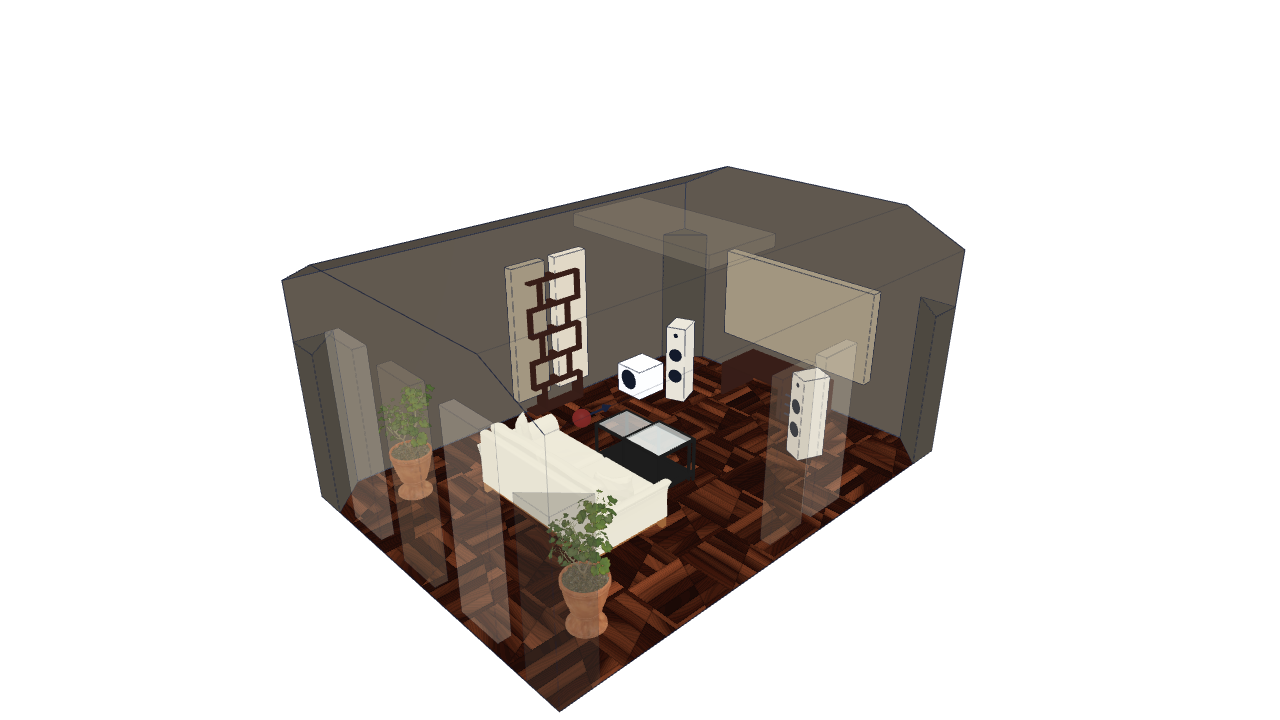
We built roomtreatment.diy to bridge the gap between complex acoustic physics and practical room design. It lets you simulate your exact room layout in a free 3D interface, showing you where standing waves form and where absorbers will yield the highest performance.
Try your room in the simulator, inspect the physics, and make your space sound incredible.