Key Takeaways:
- The Room is an Acoustic Filter: Uncontrolled room boundaries create 15–20 dB frequency response peaks and nulls that distort high-end audio gear regardless of driver quality.
- Digital Room EQ Cannot Fix Phase Nulls: Boosting a 60 Hz modal null with software EQ forces amplifiers to pump out 4× the power into an acoustic cancellation zone, causing distortion and speaker strain.
- Physics over Guesswork: Accurate low-end response requires managing 3D spatial standing waves and mirror-point reflections through calculated speaker placement and targeted acoustic absorbers.
You spent months researching audio gear. You picked out precision reference monitors or high-end audiophile towers, paired them with a clean DAC and pristine amplification, and set them up on your desk.
Then you played your favorite track.
The low end felt boomy and muddy. Certain bass notes rang out twice as loud as others, while kick drums seemed to lose all impact. Vocals sounded slightly pulled to the left, even though your speakers were measured to within of each other in an anechoic chamber.
Here's the frustrating truth: In an untreated room, you aren't listening to your speakers. You are listening to your room.
The $10,000 Audio Gear Bottleneck
When sound exits a speaker cone, it doesn't travel in a narrow beam directly to your ears. It expands spherically into the room. Within milliseconds, sound waves strike the front wall, side walls, floor, and ceiling, bouncing back to collide with the direct sound arriving from the drivers.
In an untreated room, these boundary interactions alter the frequency response dramatically:
How boundary interference builds up:
-
The left speaker sends direct sound straight to the listener's chair.
-
The same speaker's output also reflects off the side wall and arrives at the same chair, delayed and out of phase.
-
The two arrivals collide: severe phase nulls and 15–20 dB modal peaks.
-
Boundary Nulls (SBIR): When the reflection off the wall behind your speaker arrives at your chair out of phase with the direct signal, it completely cancels out that frequency. You get a deep 15–20 dB drop that no speaker upgrade can solve.
-
Low-Frequency Modal Booms: Below 200 Hz, long acoustic waves bounce back and forth between parallel surfaces. They form stationary pressure zones called room modes. A bass note played at a modal frequency takes 300 to 500 milliseconds longer to decay, muddying the entire soundstage.
-
Stereo Imaging Smear: High-frequency reflections hitting your left ear off the right wall distort the micro-timing cues your brain uses to position instruments in 3D space.
The Digital EQ Trap
The most common mistake audiophiles and producers make is trying to solve room problems with software DSP or digital room correction plugins.
It sounds logical on paper: if your measurement microphone shows a 12 dB dip at 60 Hz, why not just boost the 60 Hz band by +12 dB in EQ?
Because a acoustic null is a division by zero.
If a 60 Hz sound wave is canceling itself out due to destructive phase interference from the front wall, adding +12 dB of EQ forces your amplifier to push 16 times more power into the speaker driver at 60 Hz. The speaker cone vibrates furiously, creating harmonic distortion, but the cancellation at your chair remains almost identical. You cannot EQ out a physical phase cancellation.
Treatment Strategies: Guesswork vs. Physical Placement vs. 3D Simulation
To fix your listening space cleanly, you need to understand how different room treatment strategies compare:
| Acoustic Strategy | How It Works | Low-Frequency Null Fix () | Stereo Soundstage Clarity | Expense & Effort |
|---|---|---|---|---|
| Thin Foam Panels | High-frequency friction absorption | Fails completely (0% bass absorption) | Slightly tames flutter echo | Cheap, but ruins room tonal balance |
| Digital Room EQ | DSP amplitude compensation | Fails on phase nulls (Causes distortion) | Improves direct speaker balance | Low cost, but treats symptoms not physics |
3D Simulation (roomtreatment.diy) | Solves 3D modal wave PDE + mirror points | High (Computes exact panel & seat placement) | High (Pinpoints reflection points) | Free web tool, targets panel placement |
Finding Your Room's Sweet Spot
Fixing your room acoustics means placing the right treatment for it.
- Manage Low End First: Thick corner bass traps or targeted wall absorbers belong at high modal pressure boundaries where low-frequency standing waves accumulate.
- Clear Mirror Points: Mid-to-high frequency absorber panels should be placed at the exact mirror reflection points on side walls and ceilings to restore pinpoint stereo imaging.
- Adjust Speaker Position: Moving your speakers to their ideal position often cures a bass null without spending a single dollar on panels.
Plan Your Space with Real Physics
Instead of guessing where to stick panels or copying generic internet rules-of-thumb, you can simulate and design your exact room layout in minutes.
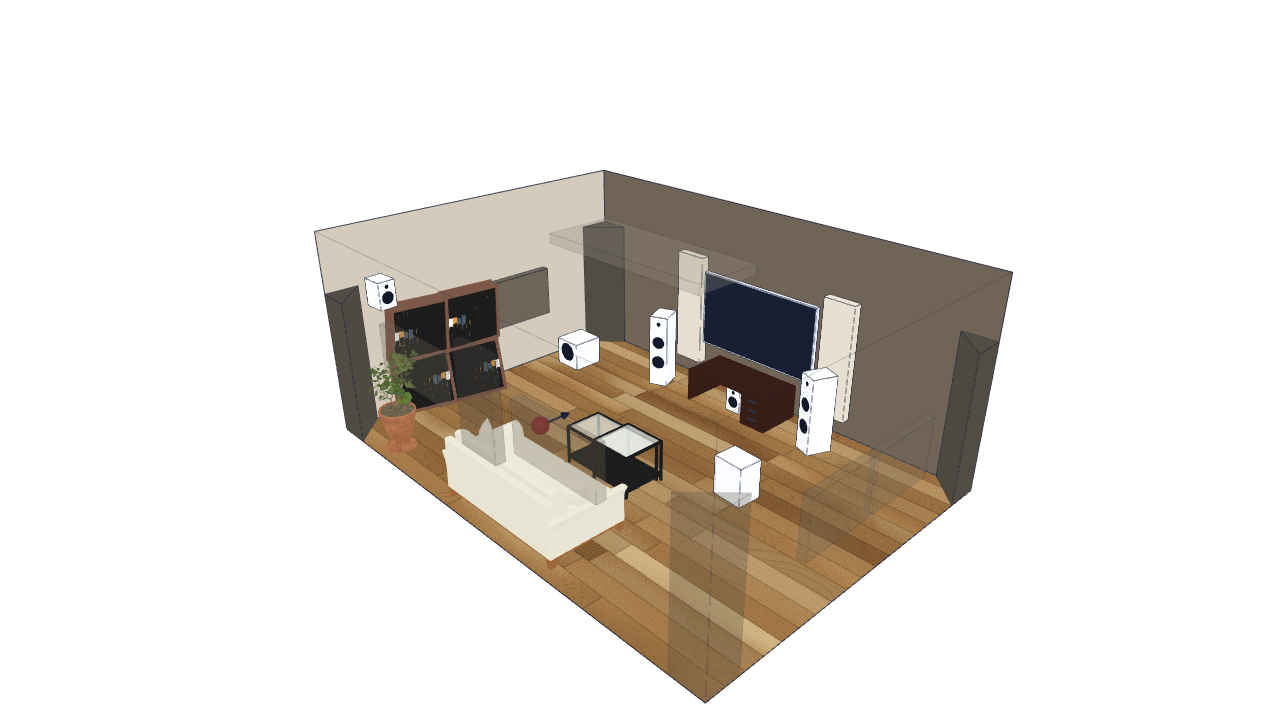
We built roomtreatment.diy to make physics-based room optimization simple and accessible. Input your room dimensions, move your speakers and desk in 3D, and watch the software compute your room modes and optimal treatment layout in real time.
Give your audio gear the room it deserves.